

SunitechAI

Categories
Career & Certification

Unleashing Agentic AI Careers: 2025 Guide to Skills, Salaries & Success

ai agent

Unleashing Agentic AI Careers: 2025 Guide to Skills, Salaries & Success

In 2023, ChatGPT made AI conversational.

In 2024, agentic AI made it operational.

And now, in 2025, the professionals behind this shift are some of the most sought-after people in tech, the AI Agent Developers. f you work in IT, software, or even a BPO setup, and you’ve been wondering how to transition into AI, this is your moment. This article is your career guide to the new wave of AI agenting – what the role means, where the opportunities are, and how to get job-ready in just a few months.

The AI Agent Developer Role: What It Actually Entails

An AI Agent Developer builds intelligent systems that don’t just process data, they take action.


These developers design AI agents capable of reasoning, collaborating, and completing complex tasks autonomously. Instead of writing thousands of lines of logic, they orchestrate LLM-based reasoning through frameworks like LangChain, LangGraph, and CrewAI.


Daily responsibilities include:


  • Designing and managing multi-agent systems that can communicate and coordinate

  • Integrating APIs, databases, and reasoning models

  • Automating workflows such as support, document handling, and analytics

  • Testing and deploying agents in production environments

If traditional AI engineers make machines smart, AI Agent Developers make them autonomous. That is the power of AI agenting, transforming reasoning into real outcomes.

Current Market Demand: 15,000+ Open Positions in India

The demand is exploding. As of October 2025, job boards like LinkedIn and Naukri list over 15,000 openings mentioning “AI Agent,” “LangChain,” or “Autonomous AI.”

Who’s Hiring

  • SaaS and product startups using AI to automate customer operations

  • Enterprise automation consultancies

  • Data-first and cloud-native companies

  • Global employers hiring Indian developers remotely

Top Hiring Cities

  • Bangalore: India’s hub for AI automation and enterprise agenting

  • Hyderabad: strong adoption by data-heavy industries

  • Pune: SaaS and DevOps companies scaling agent workflows

  • Gurugram and Mumbai: high-paying consulting and product roles

According to our internal analysis, this role has seen a 78% year-on-year growth, driven by India’s emerging dominance in the global AI services market.

Salary Breakdown by City and Experience Level

CityEntry-Level
(0–2 yrs)
Mid-Level
(3–6 yrs)
Senior
(7+ yrs)
Bangalore₹8.5 LPA₹15 LPA₹25–30 LPA
Hyderabad₹7.8 LPA₹13.5 LPA₹24 LPA
Pune₹7.5 LPA₹12.8 LPA₹22 LPA
Mumbai₹8 LPA₹14.5 LPA₹26 LPA
Source: Indeed

Remote developers and freelancers are earning $35–$90/hour, depending on their stack and project scope. AI agenting is clearly not just a future-proof skill, but a high-reward one.

Essential Skills for 2025: Technical Stack for Agentic AI

The AI agenting stack looks very different from traditional ML. You don’t need to train new models, you need to make models think and act.

Core Programming

  • Python (LangChain, FastAPI, API integration)

  • Optional: JavaScript/TypeScript for full-stack or Node agenting

Frameworks and Tools

  • LangChain and LangGraph for reasoning workflows

  • CrewAI for multi-agent coordination

  • Vector databases such as Pinecone, FAISS, or Chroma for long-term memory

  • RAG (Retrieval-Augmented Generation) pipelines for document-aware reasoning

Cloud and Deployment

  • AWS, GCP, or Azure basics

  • Docker and API hosting

Other Key Competencies

  • Prompt engineering

  • Logical problem-solving

  • Debugging distributed systems

  • Version control (Git)

If you want to see how these frameworks come together, explore our Collaborative AI Agents Workshop, a hands-on certification that walks you through real multi-agent systems.

From Our Faculty: Agentic AI Career Roadmap & Key Learning Focus

We interviewed our faculty Mr. Raju Kumar Mishra, a Principal Engineer Data Science at Altimetrik, who suggests the following actionable roadmap:


Python Foundations


To build robust agentic AI systems, you must master essential Python skills:


  • Context Management: Efficient resource and state handling within your code.
  • Asynchronous Programming: Building scalable, non-blocking applications crucial for agentic workflows.
  • Client-Server Programming: Enabling agents to communicate, exchange data, and interact in distributed architectures.

Large Language & Vision Models


Understanding the landscape of models is foundational:


  • Decoder & Encoder Models: Learning both types is vital; encoder models help create cost-effective components like routers.
  • CrossEncoders: Useful for assessing text similarity, a building block in agent coordination.
  • Multimodal Large Models: Agentic AI thrives on multimodal input, know how to leverage models that handle text, image, or audio.
  • Small vs. Large Models: Not all tasks need large, expensive models, smaller models can be more efficient for targeted agent tasks.
  • Reasoning Models: These models improve problem-solving and decision-making capabilities of agents.

Prompt & Context Engineering


The ‘brain’ of every agentic AI system is powered by effective communication with large models:


  • Prompt Engineering: Learn to craft concise, informative prompts that yield accurate, actionable responses from LLMs.
  • Context Engineering: Ensure the prompt contains necessary context so agents can correctly plan, choose actions, or communicate.

Agents & Frameworks


Deep knowledge of agent architecture and frameworks will accelerate your development:


  • Agent Architectures: Understand the structures that enable autonomous reasoning, planning and collaboration.
  • Framework Selection: Familiarize yourself with available agentic frameworks to choose the best fit for your applications.
  • Protocols: Master protocols such as Agent2Agent and ACP to build secure and robust agentic systems.

Mastering Model Context Protocol (MCP)


To create reusable, scalable agentic components:


  • MCP Integration: Develop your capacity to implement MCP, the backbone for secure, flexible multi-agent coordination in production AI systems.

Learning Path: From Zero to Job-Ready in Six Months

If you’re starting today, here’s a structured six-month path designed for Indian professionals:

Month 1-2: Foundation

  • Learn Python, APIs, JSON, and data structures

  • Understand how LLMs work through OpenAI or Mistral APIs

  • Build simple chat interfaces using Streamlit

Month 3-4: Intermediate

  • Learn LangChain and build your first single-agent workflow

  • Connect agents to vector databases

  • Automate small tasks like email summarization or data lookup

Month 5-6: Advanced

  • Move to LangGraph or CrewAI to handle multi-agent coordination

  • Deploy your first real project

  • Document and publish it on GitHub or your portfolio

By the end, you should have two working projects and the skills to apply confidently for an AI Agent Developer role. Fast-track your journey by joining our Collaborative AI Agents Workshop, where you’ll build production-ready agents with expert mentorship.

Certification Value: What Employers Actually Look For

Today’s recruiters focus less on generic AI certificates and more on practical proof.
They want developers who can build deployable systems, collaborate with LLM APIs, and reason about workflows.


That’s why SunitechAI’s certification focuses on:


  • Real-world agentic projects

  • Collaborative problem statements

  • Feedback from active industry mentors

  • Deployment experience and evaluation

Our certification is recognized by 50+ Indian tech companies actively hiring AI Agent Developers. It is designed to make you industry-ready, not just course-ready.

Landing Your First Role: Portfolio Projects That Get Attention

When it comes to hiring, your portfolio matters more than your résumé. Here are a few project ideas that make an immediate impression:


  • AI Email Agent: reads, summarizes, and drafts replies

  • Customer Support Agent: RAG-based query responder for a product

  • Task Automation System: multiple agents managing user workflows

  • Resume Evaluator Agent: helps recruiters screen candidates

Publish them on GitHub, write a short blog about your build process, and link everything on LinkedIn. Employers look for developers who can show their reasoning, not just describe it.

Conclusion

AI agenting is no longer experimental, it is the foundation of how future systems will operate.
India’s vast tech ecosystem and developer community are uniquely positioned to lead this change.

Whether you are a software engineer, data analyst, QA professional, or someone in operations, transitioning into AI agenting can redefine your career. The tools are accessible, the community is growing, and the opportunities are multiplying.


If you’ve been waiting for the right time, this is it.


Get certified. Get connected. Build intelligent, reasoning systems with SunitechAI.

Facebook
Twitter
LinkedIn
Empower Your Employees with Cutting-Edge Data Science Skills through Excelerate
Categories
Uncategorized

The Secret Sentinels: Unveiling Anomaly Detection for Modern Businesses

The Secret Sentinels: Unveiling Anomaly Detection for Modern Businesses

In the ever-evolving landscape of Data Science, Anomaly Detection stands out as a pivotal technique, empowering businesses to safeguard their operations and optimize their processes. Hence, understanding the nuances of this powerful tool is essential for every Data Science professional, Mid-level Manager and Researcher. Our case study delves into the intricate world of anomaly detection, highlighting its transformative impact and our AI courses deal with the topic in great detail.


Imagine a scenario where a financial institution detects fraudulent transactions in real time, preventing potential losses and securing customer trust. Or consider a healthcare provider identifying unusual patterns in patient data, leading to early diagnosis and improved treatment outcomes. These industry-specific examples which are discussed in our Applied Data Science and Artificial Intelligence certification, underscore the critical role Anomaly Detection plays in enhancing operational efficiency and driving strategic decision-making.

What is an Anomaly?

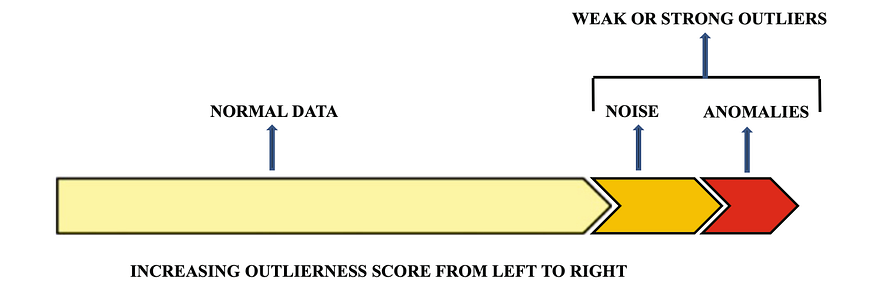
An outlier or anomaly is a data point where the actual value deviates significantly from the model’s prediction. These can arise from various sources, such as incorrect data recording, noise or the presence of data from a different distribution — imagine a few grapefruits mixed with oranges or a rare 7-foot-tall individual. While outliers may include irrelevant noise, anomalies are the intriguing outliers we focus on. Noise acts as the boundary between normal data and true anomalies, often appearing as weak outliers that don’t meet the criteria to be considered noteworthy. For instance, data points on the edges of clusters are often labeled as noise rather than anomalies. Understanding this distinction is crucial in anomaly detection, enabling us to filter out the irrelevant and zero in on data points that offer valuable insights.

The above figure shows the spectrum from normal data to outliers.

“Outliers are not necessarily a bad thing. These are just observations that do not follow the same pattern as the other ones. But it can be the case that an outlier is very interesting. For example, if in a biological experiment, a rat is not dead whereas all others are, then it would be very interesting to understand why. This could lead to new scientific discoveries. So, it is important to detect outliers.”
— Pierre Lafaye de Micheaux, Author and Statistician

Outlier Detection Algorithms

Outlier detection algorithms build a model of normal data patterns and then evaluate how much a given data point deviates from these patterns, assigning it an outlier score. The choice of the model is critical; an incorrect model can lead to poor results. For example, a linear regression model may perform poorly if the data is arbitrarily clustered, incorrectly flagging data points as outliers due to a poor fit with the model’s assumptions. Therefore, selecting the right model requires understanding the relevant deviations for your specific application. Some common outlier detection algorithms include –

Isolation Forest


The Isolation Forest algorithm is a powerful tool for anomaly detection, designed to ‘isolate’ observations by randomly selecting features and split values within their range. This process creates a tree structure, where the number of splits needed to isolate a sample equates to the path length from the root to the terminating node. Averaging these path lengths across a forest of random trees provides a measure of normality — anomalies produce noticeably shorter paths due to random partitioning. When a collection of trees consistently shows shorter path lengths for specific samples, those samples are likely anomalies. Isolation Forest is particularly efficient for outlier detection in high-dimensional datasets, offering a robust method to identify unusual patterns.

Local Outlier Factor

Another effective approach for outlier detection in moderately high-dimensional datasets is the Local Outlier Factor (LOF) algorithm. LOF computes a score reflecting the degree of abnormality of each observation by measuring its local density deviation relative to its neighbors. The core idea is to identify samples with significantly lower density compared to their surrounding points. The local density is derived from the k-nearest neighbors, and the LOF score is the ratio of the average local density of these neighbors to the point’s local density. Normal instances have similar densities to their neighbors, whereas anomalies exhibit much lower densities.

The LOF algorithm’s strength lies in its ability to consider both local and global properties of the dataset, performing well even when anomalies have different underlying densities. It focuses on how isolated a sample is within its neighborhood, rather than in the entire dataset.

Angle-Based Outlier Detection (ABOD)

ABOD differs from traditional distance-based methods by assessing the variance in the angles between the difference vectors of a point to the other points. This approach is particularly effective in high-dimensional data, where distance-based methods often deteriorate due to the “curse of dimensionality”

The ABOD method has several advantages, including not relying on any parameter selection that could influence the quality of the achieved ranking.

k-Nearest Neighbors Detector

It measures the distance of an observation to its kth nearest neighbor, which serves as the outlier score. This approach is based on the idea that outliers will have larger distances to their neighbors compared to inliers. The following three methods can be used to calculate the outlier score: using the distance to the kth neighbor (largest), the average distance to all k neighbors (mean), or the median distance to k neighbors (median).

Local Correlation Integral (LOCI)

The Local Correlation Integral (LOCI) method excels at identifying outliers and groups of outliers, also known as micro-clusters. LOCI offers unique advantages compared to traditional methods. Firstly, it automatically determines a data-driven cut-off to classify points as outliers, eliminating the need for users to manually set cut-off values. Secondly, LOCI provides a LOCI plot for each point, offering a comprehensive summary of the data in the vicinity of the point, including clusters, micro-clusters, their sizes, and inter-cluster distances. This feature-rich approach stands out as it provides more detailed information compared to methods that output a single outlier score for each point.

In practice, LOCI works by computing the local correlation integral, which measures the density of points in the neighborhood of a given point. By analyzing the local structure of the data, LOCI can effectively identify outliers and micro-clusters based on the density and relationships between neighboring points. This method is particularly valuable for its ability to offer detailed insights into the data distribution and to automatically determine outlier cut-offs, making it a valuable tool for anomaly detection in various applications.

Feature Bagging

Feature Bagging is a meta-estimator designed for outlier detection that enhances predictive accuracy and controls overfitting by fitting multiple base detectors on different subsets of the dataset and combining their predictions through averaging or other methods. This method constructs multiple sub-samples by randomly selecting a subset of features, inducing diversity among the base estimators. The prediction score is then generated by aggregating the outputs of all base detectors, providing a robust measure of outlier likelihood for each observation.

Python Outlier Detection (PyOD)

PyOD is a versatile Python library tailored for detecting anomalies in multivariate data, making it ideal for projects of all sizes. Whether you’re working with small-scale datasets or tackling larger ones, PyOD offers a comprehensive suite of over 50 detection algorithms, from classical approaches like LOF to cutting-edge methods like ECOD and DIF.


Designed by Yue Zhao, Zain Nasrullah, and Zheng Li, PyOD addresses the need for a robust outlier detection tool. It stands out with its open-source nature, detailed documentation, and practical examples for a variety of algorithms. Key features include support for advanced models such as Neural Networks, Deep Learning, and Outlier Ensembles, optimized performance through JIT compilation and parallelization using numba and joblib, and a thorough performance evaluation via ADBench: Anomaly Detection Benchmark, which compares 30 algorithms across 57 datasets.

Artificial Intelligence Courses

At SunitechAI, we empower professionals to leverage tools like PyOD to elevate their data science and AI skills, driving innovation and excellence in their careers. Check out our Anomaly Detection case study to master these cutting-edge techniques and stay ahead in the dynamic tech landscape.


Elevate your data science expertise with SunitechAI’s Applied Data Science in Enterprises certification. Master Descriptive Statistics, Supervised and Unsupervised Learning, Anomaly Detection, Recommendation Systems, Time Series Forecasting, and Deep Learning. Apply these models to real-world use cases like demand prediction, fraud detection, and image recognition on a cloud platform, and deploy them to an endpoint. Empower yourself to lead and innovate in the dynamic field of data science. Join us and transform your career today!

Facebook
Twitter
LinkedIn

Kickstart your AI Career, learn what top AI startups teach their teams. Join our LLM & Agentic AI Program.